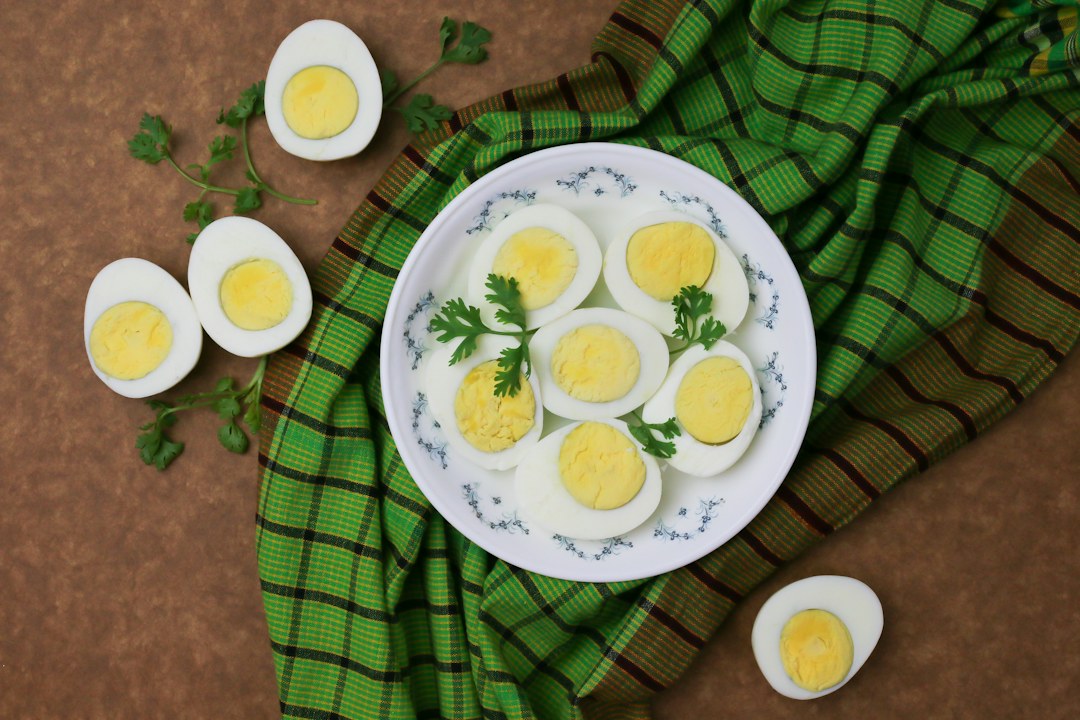
This cottage cheese egg salad without mayo uses a smooth cottage cheese dressing to bind chopped hard-boiled eggs, crisp celery, fresh dill, and chives. Lemon zest adds brightness without pouring extra liquid into the bowl, and a little Dijon gives the filling a savory tang.
With already cooked, cooled eggs, the salad takes about 15 minutes. The most useful trick is controlling moisture: drain any pooled liquid from the cottage cheese, dry the eggs and celery, and mix only after the eggs are cool. That makes a creamy filling that stays on the bread instead of soaking through it.

Cottage Cheese Egg Salad Without Mayo (Lemon & Dill)
Prep: 15 minutes Cook: 0 minutes using cooked eggs Total: 15 minutes Yield: 4 servings (about 1/2 cup each)
Ingredients
- 8 large hard-boiled eggs, fully cooled and peeled
- 3/4 cup (170 g) 2% cottage cheese, drained of any visible pooled liquid
- 2 teaspoons Dijon mustard
- 1 teaspoon fresh lemon juice
- 1 teaspoon finely grated lemon zest
- 1/4 cup finely diced celery, patted dry
- 2 tablespoons finely chopped fresh dill
- 1 tablespoon finely chopped chives
- 1/4 teaspoon ground black pepper
- 1/8 teaspoon fine salt, or less depending on the cottage cheese
Directions
- Blend the dressing: Place the cottage cheese, Dijon mustard, lemon juice, lemon zest, and black pepper in a small food processor. Process for 20 to 30 seconds, scrape down the sides, then process again until mostly smooth. If you prefer the curds, mash thoroughly with a fork instead; the dressing will be chunkier.
- Chop the eggs: Pat the peeled, fully cooled eggs dry. Chop into roughly 1/2-inch pieces. Keep some larger white pieces for texture rather than mashing every egg into a paste.
- Fold together: Put the chopped eggs in a bowl. Add the cottage cheese dressing, celery, dill, and chives. Fold gently with a spatula until evenly coated. Do not blend the eggs with the dressing.
- Season and serve: Taste before adding the salt because cottage cheese and mustard vary. Add up to 1/8 teaspoon salt if needed. Serve cold in lettuce cups, on toast, or in a sandwich, or cover and refrigerate promptly.
Estimated nutrition: 195 calories, 17g protein, 4g carbohydrate, 12g fat, 0.3g fiber, and 420mg sodium per one-fourth of the salad, without bread or serving extras. Nutrition is an estimate; egg size, cottage cheese, mustard, and portion size affect the values.
Why this egg salad stays creamy
- Use a thick cottage cheese. A small-curd 2% or full-fat variety works well. Spoon off visible whey or drain in a fine-mesh sieve for 5 minutes before measuring; do not squeeze it completely dry.
- Cool and dry the eggs. Warm eggs loosen the dairy dressing, while water clinging to peeled eggs thins it further.
- Use zest for lemon flavor. The teaspoon of juice is enough to season the dressing; zest adds aroma without extra moisture.
- Fold, rather than purée, the eggs. Blending all the ingredients can make a loose paste. Keep the whites in small pieces and blend only the cottage cheese dressing.
Starting with raw eggs
The 15-minute recipe time assumes hard-boiled eggs are already available. To cook a fresh batch, put eight eggs in a saucepan in a single layer and cover with cold water by 1 inch. Bring to a boil, cover, remove from the heat, and stand for about 12 minutes for large eggs. Transfer to an ice-water bath for 10 minutes, then peel. Allow roughly 30 extra minutes for heating, cooking, and cooling; timing varies with pan size, starting temperature, egg size, and altitude.
Cut one egg to check that both the yolk and white are firm. If it is undercooked, return the unpeeled remaining eggs to simmering water for a few more minutes and cool again. Wash hands, the saucepan, and work surfaces after handling raw eggs. See the FDA’s egg-safety guidance.
Common questions and useful variations
Do I have to blend the cottage cheese?
No. Blending makes a dressing closer in texture to mayonnaise, but a fork-mashed cottage cheese dressing works if you enjoy small curds. A mini food processor is easier than a large blender for this small amount. Do not add water simply to get a large blender moving; that can make the salad runny.
Why is my cottage cheese egg salad watery?
The usual causes are a wet cottage cheese, warm eggs, or vegetables that were not dried. Drain the cheese before blending and use cold, dry ingredients. If a finished batch has a little liquid at the bottom, spoon off the liquid and stir gently. For the next batch, reduce lemon juice to 1/2 teaspoon. Extra mustard or more salt will not fix excess moisture.
Can I make this with low-fat cottage cheese?
Yes, although nonfat and 1% brands can be thinner. Drain visible whey and start with 2/3 cup if your brand looks especially loose, adding the remaining tablespoon or two only after folding in the eggs. The result may be less rich, and nutrition will vary.
Can I add pickles or make it spicy?
Fold in 2 tablespoons finely diced dill pickles that have been blotted dry, or add 1/8 teaspoon cayenne to the dressing. Avoid adding pickle juice as well as lemon juice; both increase moisture. For a mild variation, replace dill with parsley and keep the chives.
What should I serve it with?
For a sandwich, use toasted whole-grain bread and put a dry lettuce leaf between the filling and the bread. Lettuce cups, cucumber rounds, and bell-pepper halves are useful lower-carb serving options. Bread and other serving extras are not included in the nutrition estimate.
Storage and lunch packing
Refrigerate the salad promptly in a shallow, covered container at 40°F or below. Use within 3 days for best quality and never later than 7 days after the eggs were originally cooked, whichever comes first. The general food-safety limit for egg salad is 3 to 4 days; this recipe uses the shorter end because cottage cheese can release moisture. See FoodSafety.gov’s cold-storage chart.
Keep the salad cold in an insulated lunch bag with ice packs. Discard it if it has been above refrigerator temperature for more than 2 hours, or more than 1 hour when the surrounding temperature is above 90°F. Pack bread separately and assemble just before eating. Serve cold; reheating is not recommended, and freezing gives the eggs and dairy a watery, rubbery texture.
More easy lunches and egg recipes
For another chilled lunch, try Tuna and White Bean Salad. For warm cottage cheese and eggs, make Cottage Cheese Spinach Egg Bake. For a make-ahead lunch with vegetables and chicken, see Greek Chicken Cucumber and Feta Salad Bowls.
Helpful kitchen gear
Amazon Associate disclosure: As an Amazon Associate, MealMadeBright earns from qualifying purchases.
A small food processor can smooth the cottage cheese without needing extra liquid. A fork is a practical alternative if you prefer a textured dressing. Use equipment you already own whenever possible.
Browse small food processors on Amazon. Compare usable capacity, materials, cleaning instructions, and current reviews before choosing one.